I made this on xtranormal.com last night to summarize the typical 'Oh, so you want to leave school during your working hours?' conversation.
You can find other xtranormal videos about teaching in Korea on youtube as well, made by many a perplexed Guest English Teacher just trying to cope with humor.
Showing posts with label funny. Show all posts
Showing posts with label funny. Show all posts
Tuesday, July 12, 2011


Tuesday, May 31, 2011
haiku in honor of my afternoon snack, vi.
Ice cream in a bag,
You are my hot, summer joy.
You won't melt on me.

I'll admit-- the first time I laid eyes on these little contraptions, it seemed unnatural. I mean, this is ice cream... if I can't see it, and lick it off a cone, what good is it to me? All it took was one squeeze and I was sold. Not to mention, it's got all the flavor of ice cream but it's not as heavy on the cream. It's becoming blatantly obvious as to how these Koreans stay so flippin' thin.
Summer weather, come swiftly. I gotsta get my ice-cream-in-a-bag on.
Friday, April 22, 2011
My students' notebooks are cuter than yours.
No, seriously; they are.
Any foreign teacher in Korea will tell you that the school supplies here are off-the-charts adorable. Usually when I walk around my classroom, my students get all nervous because I peer at their desk. They think I'm thoroughly checking their work, but it only takes approximately 0.7 seconds to proof-read, "Go straight and turn right." Nay, I am desperately trying to memorize their Konglish-riddled pencil cases and notebooks.
For those of you just tuning in, I'll elaborate. Depending on who you ask, 'Konglish' is a term referring to either
a) The Korean words that sound exactly like English ones (although this linguistically would be referred to as a dipthong)
or b) The poetic, romantic and completely incorrect English sentences crafted by Korean manufacturers and put all over t-shirts, billboards, and-- of course-- school supplies.
I've been wanting to snap some photos of the rare and beautiful[ly silly] Konglish notebooks for some time now, but it looks a little suspicious to whip out a camera and start taking pictures of merhandise in a store. However, while grading notebooks the other day, I realized I had the perfect opportunity in front of me, stacked 18 inches high.
So without further adieu:


The thing that amuses me is that, no matter how many jokes I make about these damn school supplies, I know I will be returning to the States with a box full of them.
Any foreign teacher in Korea will tell you that the school supplies here are off-the-charts adorable. Usually when I walk around my classroom, my students get all nervous because I peer at their desk. They think I'm thoroughly checking their work, but it only takes approximately 0.7 seconds to proof-read, "Go straight and turn right." Nay, I am desperately trying to memorize their Konglish-riddled pencil cases and notebooks.
For those of you just tuning in, I'll elaborate. Depending on who you ask, 'Konglish' is a term referring to either
a) The Korean words that sound exactly like English ones (although this linguistically would be referred to as a dipthong)
or b) The poetic, romantic and completely incorrect English sentences crafted by Korean manufacturers and put all over t-shirts, billboards, and-- of course-- school supplies.
I've been wanting to snap some photos of the rare and beautiful[ly silly] Konglish notebooks for some time now, but it looks a little suspicious to whip out a camera and start taking pictures of merhandise in a store. However, while grading notebooks the other day, I realized I had the perfect opportunity in front of me, stacked 18 inches high.
So without further adieu:

It may or may not come as a surprise that the phrase, "Let's go together" is incredibly common here...
so much so that I find myself using it in everyday conversation now. Oh boy.

Pictured on this notebook is a shot of the London Eye. Notebooks here often show cityscapes of famous locations around the world, and come complete with a caption that either a) was lifted directly from Wikipedia and is incomprehensible to most Korean schoolchildren, or b) has a lot of advanced English words, but is not applicable to every day English (pictured above).

"Special day!"... "How are you?"... "Love is a splendid thing"... what do all of these phrases have in common? Nothing, but the smiling ice cream doesn't seem bothered by that.

This caption's intent is supposed to be romantic, but kind of comes off a little stalker-esque.

That's right. People have to be redeemed redeemed.

Not related but really cute: my student wrote "over" at the end of their homework. I gave them a smiley.

Even Snoopy is not free from the powers of Konglish.

This one is actually pretty cute. It's a stunning example of all the times mushy love quotes go right on Korean notebooks. I can't tell you how many times I've seen "I'll wait for you forever" on a book, pencil, eraser (okay, maybe not an eraser; that would be kind of an oximoron).
The thing that amuses me is that, no matter how many jokes I make about these damn school supplies, I know I will be returning to the States with a box full of them.
Thursday, April 7, 2011
For poop's sake.
This is a class schedule in one of the 5th grade classrooms, created by the female homeroom teacher. When I mentioned the irregularity (har har) of the theme this teacher chose, my co-teachers didn't seem to understand what I meant.

As someone who has probably spent too much time being distracted by this schedule when I teach in the classroom where it resides, allow me to point out some of the finer qualities you see here:
1. The vindictive look on the faces of each crazed child as they send turds raining from... well, you know where.
2. The color-coded pooplets. By the way, English class is red.
3. The squatter toilets! They don't make 'em like that in the States.
This post could easily branch out into an entire questioning rant about my confusion regarding Korea's obsession with turds. However, I'm going to leave it here, because there are really no answers to be found at the moment, and with each sentence I type I'm tempted to make some kind of joke about the digestive system. It's getting difficult to constipate. I mean, concentrate. It's getting difficult to concentrate.
Sheesh.
Friday, March 18, 2011
Edu-tainment: When I use the education materials to entertain myself.
As a Guest English Teacher, I've often been told that our role in the school runs somewhere along the line between a teacher of our native language and a court jester from the Medieval times-- that is, we are part instructor and part entertainer (shaken, not stirred).
This puts us in the line of business cleverly labeled 'edutainment'... and oh, how I love and despise it equally.
The last time I had a visitor in Korea, it was brought to my attention that there are some strange things about the way children learn English here. I mean, sure-- overall, Korea's programs are pretty effective. But I guess when the consumers of this English-crazy material had lessons on grammar and vocabulary since you were 7, the people producing these learning tools have to start thinking outside the box to keep students focused.
Or perhaps it's another one of those cultural lenses I just don't see through with quite the same perspective. Sometimes, things which are supposedly obvious to Koreans don't register with me.
Either way, it's all edu-tainment to me.
The following series of photos were captured from an English poster in our staff room. There are no captions to go along with these "English 365" photos, so I decided to make some of my own from the more... interesting pictures.

"Hey Bill, you want this fish? It's about to go bad, and it smells like socks, but you look like you're fish-deprived based on that crazy look in your eyes."
"ZOMG I LOVE FISH. THAT'S WHY I ALWAYS CARRY THIS FORK! NOM NOM NOM"

"Look! It's the elusive bald fairy I've been searching for my whole life. It just flew off my shoulder and into the sky! Do you see it??? DO YOU SEE IT?!"

"WTF where did all this grey hair come from?! GET IT OFF GET IT OFF GET IT OFF!!!"

This picture, I assume, is depicting two people talking about their favorite animal (let's hope). But what is the thing on the left? Is it a monkey? A cat? A sad, deformed hamster?

The guy on the left appears pretty blissfully ignorant to his friend's sad state:
"George... it's... it's so hot... could I have a sip of your water?"
"Oh, you mean this water? You're right, Joe; it's been just sweltering today, but look how jolly I am with this water... it's amazing what some hydration can do for you. Say, you should drink more water, Joe. You don't look so good."

"낙서" (nak-seo) means "graffiti", which just makes this picture funny by virtue.
Got any clever captions? Please post them in the comments below or send them to playingwithelephants@gmail.com.
Cheers to the weekend!
Wednesday, January 26, 2011
A haiku in honor of my afternoon snack, iv.
What's this I'm seeing?
Not meat, but not chips either:
Chicken-shaped delights.

Okay, so maybe South Korea could fault the States for our dino-shaped chicken nuggets. But at least it's still chicken meat (kind of).
Weapons of teaching warfare.
The month of January has almost come to an end, and with it comes the end of Winter Camps. Virtually every foreign teacher has their own personal version of hell they can relay from camp (although some teachers lucked out and actually loved their placement), but the bottom line is that the life-sucking power from these programs really took a hit on blog posts.
I find it only appropriate to pass along some wisdom and humor at this point. While the students were learning vocabulary and grammar, what was I learning?
I mean, besides the Korean word for period (마침표, or ma-chim-pyo), since my students can never remember to use one and it's really annoying
Well, when you go into the classroom battle zone, sometimes it's good to be prepared with teaching weapons. These items are absolutely not necessaries for a teacher (and depending on the classroom could even be a distraction), but in the world of edutainment, they are definitely useful tools that gain student interest and focus attention on the lesson. Obviously, Winter Camp was the perfect place to introduce these weapons of classroom warfare into my teaching routine.
1. Pointer
For Guest English teachers, 'listen and repeat after me' drill portions of a lesson are a necessary part of student-teacher interaction. It's useful to have something to point with, especially if you're short and the television screens are at an uncomfortable height above your head (and you're wearing a short dress in a room of 6th grade boys... it may have happened once). Pointers are also a universal symbol of power among your students, so you're sure to earn some street cred if you carry it around with a stoic look on your face (although I don't know how much my kids respect this one since it looks like the gesture for 'scissors' in Korean Rock-Paper-Scissors).

2. Soft Ball
For games, random quizzing, or a de-stress mechanism, I highly recommend the squishy ball. 'Pass the Ball' games are pretty common in Korean lessons, so playing ball games may not even take too much explanation (which can be a challenge for some English teachers). Not to mention, if you can juggle or do anything else somewhat impressive, more street cred!

3. Big Plastic Whistle
Although used sparingly, this is probably my favorite teaching tool. The big plastic whistle was a gift from another native teacher specifically for Winter Camp, and it has been the envy of many a teacher since its arrival into my life. Its use is also multi-faceted-- games, Sports Days, or bringing a 20-some group of rowdy Korean students to their seats in mere seconds-- making it a really awesome addition to my armory. I generally keep this baby hidden so it never loses its shock value when I pull it out of my bag of tricks.

Remember, teaching has way more to do with methodology, commitment to the learning objectives, classroom management, and passion for student success than the flash and frills of some dollar-store toys... but as edutainers in a world where the native language is not our own, sometimes it's okay to stick with the old adage that all's fair in love and war. And teaching definitely falls into both categories.
PS: If anyone caught the irony of the missing period in this post, give yourself a cookie.
Monday, January 17, 2011

Thursday, January 13, 2011
You know you're a foreign teacher in Korea when...
you find humor and perhaps even complete joy in waving ridiculously at all the Koreans who stare at you.
Microsoft Office in Korean characters stops seeming like such a beast and more like the program you used to be friends with.
eating octopus is not only not an accomplishment, but has become practically an essential food group.

you use the universal sign of acknowledgment, 네 (or ney), around everyone, including non-Koreans.
the best part of your day is coming home and laying on your heated floor.
you can't imagine your life in winter without a hat and scarf, or anything else that will assist in covering every square inch of your body 3 times over.

your Korean co-teachers can't eat the soup you just finished because it was too spicy for them.
that fateful day comes that you accept that standing on public transportation is not only polite, but convenient for you since all the elders will glare until you stand up anyway.
you value stickers and candy more than the won, because it's the only thing that will motivate your students on 'those' teaching days.

conversations among teachers after work include over-exaggerated hand gestures and accentuated pronunciation.
your planner is full of Konglish and cartoon stickers from your students, completely killing any chance of getting that date you were trying to plan when you pulled out your planner to begin with (damnit).
everything seems to smile at you.

you cringe at catch phrases such as "so-so" and "I'm fine, thank you. And you?"
the best scolding you've given all week is, "WHY HOMEWORK NO? DO YOUR HOMEWORK. YOU MAKE TEACHER SAD."
you find yourself improvising choreography for a song aptly titled, "I Like Oranges"... in front of your 3rd graders... after hearing it once.
To all my fellow teachers in Korea, you're daily, crazy, outright heroes.
Here's to you.
-Laura
Thursday, January 6, 2011
A haiku in honor of my afternoon snack, iii.
Uncomfortable.
It says you are chocolate but...
I'm really not sure.

And here's a picture of the bag, just so nobody thinks anything funny is
going on.
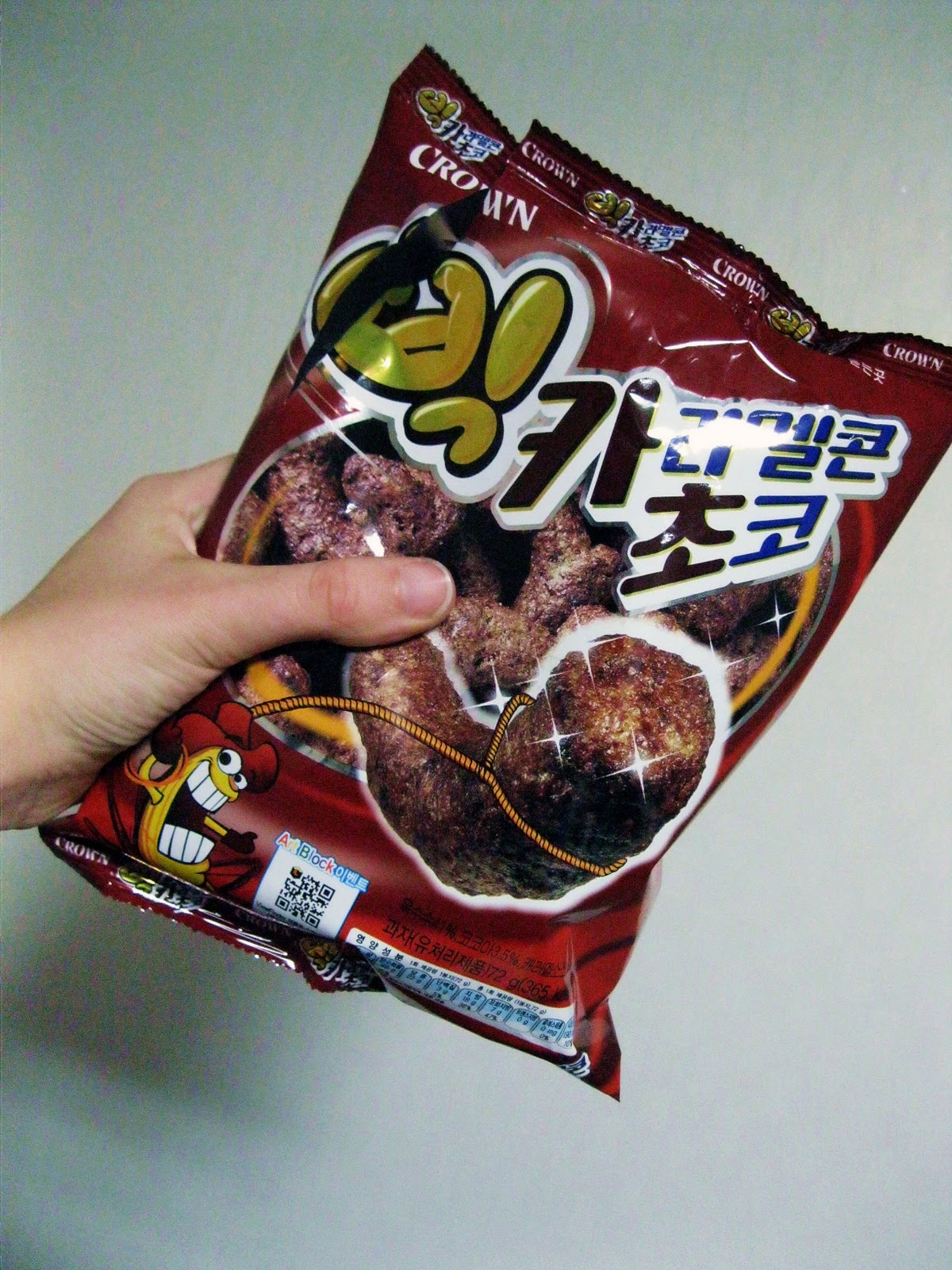
The bag indicates that these are called, "Big Caramel Chocos." They have the taste of Count Chocula, but obviously the shape of something that crazy vampire would find in his toilet.
Yummy.
Thursday, December 23, 2010
My Korean Kristmas.
Hopefully the title of this post didn't offend anyone who celebrates Christmas, but things here aren't quite the same as back at home. A few people have asked me about what Christmas is like in South Korea (because, yes, they do have Christmas here, with lights and trees and presents), but it's difficult to explain the subtle differences. As I've said before, no culture is better or worse, so this comparison is just for laughs and might put a new spin on how you choose to celebrate the season. Now, enough of the disclaimers. Let's compare.
Christmas light in the US:
Ah, nothing says "it's Christmas" like 5,000 colored bulbs timed to music.
Christmas lights in Korea:
... well, screw the colored lights. Nothing says "it's Christmas" like seasonally manicured nails.
Christmas carols in the US:
Another cultural fad, flash mobs, rock the Christmas season anywhere the people are (near fast food and shopping centers).
Christmas carols in Korea:
A whole different kind of fad hits Korea during Christmas, and her name is Mariah Carey.
In America, we like to make our lights do all the work at the zoo (AGAIN with the colored lights?!).
Christmas zoos in Korea:
In Korea, the animals prefer to get into the holiday spirit (or do they?...).
So, as you can see, Christmas is here, but it just isn't the same.
Friends and family, thank you for all the love and support from afar as I spend my first Christmas on my own. It's been beautiful and a little bittersweet, but knowing you are all still there and think of me makes everything about this season whole.
Followers of my blog whom I have yet to meet, thank you for taking the time to read about my adventures. I would like to extend the warmest wishes to you and your loved ones this season, whoever they may be and however you may celebrate.
Lastly, Korea-- thank you for giving me this wonderful opportunity to grow and find home wherever I am. It's not always easy but it's always a learning opportunity.
This will be my last post of the year, as I'm going on vacation immediately following Christmas for a weeklong trip to Seoul. Wish me luck as my friends and I troll up to the border, and expect an amazing Seoul post upon my return! See you in 2011!
Love and happiness to you all,
Laura (로라)
Christmas light in the US:
Ah, nothing says "it's Christmas" like 5,000 colored bulbs timed to music.
Christmas lights in Korea:
... well, screw the colored lights. Nothing says "it's Christmas" like seasonally manicured nails.
Christmas carols in the US:
Another cultural fad, flash mobs, rock the Christmas season anywhere the people are (near fast food and shopping centers).
Christmas carols in Korea:
A whole different kind of fad hits Korea during Christmas, and her name is Mariah Carey.
Christmas zoos in the US:
In America, we like to make our lights do all the work at the zoo (AGAIN with the colored lights?!).
Christmas zoos in Korea:
In Korea, the animals prefer to get into the holiday spirit (or do they?...).
So, as you can see, Christmas is here, but it just isn't the same.
Friends and family, thank you for all the love and support from afar as I spend my first Christmas on my own. It's been beautiful and a little bittersweet, but knowing you are all still there and think of me makes everything about this season whole.
Followers of my blog whom I have yet to meet, thank you for taking the time to read about my adventures. I would like to extend the warmest wishes to you and your loved ones this season, whoever they may be and however you may celebrate.
Lastly, Korea-- thank you for giving me this wonderful opportunity to grow and find home wherever I am. It's not always easy but it's always a learning opportunity.
This will be my last post of the year, as I'm going on vacation immediately following Christmas for a weeklong trip to Seoul. Wish me luck as my friends and I troll up to the border, and expect an amazing Seoul post upon my return! See you in 2011!
Love and happiness to you all,
Laura (로라)
Tuesday, December 14, 2010
Lessons Learned from the Life of a Guest English Teacher.
A few people have asked to read the essay I wrote for a competition this year through EPIK. Here it is, in all its 2nd place glory (yes, yes; there's my charming sarcasm again).
On a more serious note, I am so thankful that my essay was chosen, and thrilled to see that I have so many people supporting my efforts abroad, including my school, who helped me to give my plain paper essay some finishing touches in the most Korean way possible (aka: completely without my consent but utterly appreciated!).
Thanks for your kind words, positive vibes, and endless encouragement.
And for anyone who reads this in its entirety... you're rad.
Lessons Learned from the Life of a Guest English Teacher
I don’t think I can express just how different every foreigner’s experience is when they move to a new place. In fact, the one thing every foreigner likely does have in common when they think about their life in Korea is that it’s nothing like they imagined it would be. Talk about room for personal and professional growth! Here are some of my own stories from this transition to Korea so far, and the lessons I’ve gleaned from them:

Expect adventures in Korean dining.
I’ve had some interesting experiences just trying to eat in Korea. I love Korean food, but had to give up some of my own stubborn eating habits in order to truly enjoy it. When I first arrived in Korea, I was a vegetarian and wanted to maintain that dietary standard. However, after a few strange encounters with restaurant food, I decided a little meat in my diet wouldn’t be the worst thing after all. This first comedic incident occurred before I even left EPIK Orientation, and it‘s one I‘ll never forget:
Sitting with my friends in a Korean barbeque with virtually no knowledge of the Korean language, no readable menu, and my dietary needs... we defaulted to the other foreigners we saw in the restaurant, and enlisted their help. This resulted in one of the most awkward experiences I've had to date. Soon our fellow foreigners and the Korean servers were in what appeared to be a discussion over why someone would willingly come to a barbeque when they don't eat meat. If that wasn't enough, they all began pointing at me from across the restaurant so we could clear up this debacle. It was hard not to sink in my chair from this point on, especially when they came over and laughed when I verified that I really couldn‘t eat anything on the menu.
The lesson I would like to pass on from this night is that one should always come prepared to dine in a foreign country. The Korean culture is very hospitable and the women working that night definitely didn’t let me go hungry, but I certainly could have been more helpful if I was aware of some options to ask for in advance. Of course, there is always the possibility that the etiquette of a new culture will provide enough of a challenge. Here are some feelings from my first experience dining out with my school:
It’s my first staff meal and I feel completely lost. In the United States, I would be contributing to the conversation and making jokes. In Korea, I’m not even sure when I’m supposed to pour the water, which way to put my chopsticks, or even how to eat many of these dishes! These factors, in combination with the language barrier, make me about as comfortable as sitting on the floor does. Both I’m going to have to get used to. For the first time, I felt so socially out of place I thought I might begin to spill tears in the middle of lunch; not the impression I want to make on my new Principal and staff! Fortunately, one of my co-teachers told me not to worry. “We’re all very nice, don’t be nervous” she said. Those few words were enough for me to keep trying to cut fish with my chopsticks.
Although I still can’t cut fish properly with my chopsticks, I have learned how to act socially-presentable on a variety of other levels since moving to Korea. A few days after this lunch, I had a private meal with my co-teacher and took the time to ask her about proper eating manners in Korea. At first, I was a little embarrassed to ask her which way I should place my chopsticks between bites, but she seemed more than happy to help me adjust to Korean culture. Now that I see how eating together is an important part of social and professional life, I sometimes wish I had received a lesson on manners in Korean dining from the EPIK Orientation. It certainly would have helped to boost my confidence when taking those first few meals together as a school!

Learn some of the history.
Upon arriving at EPIK Orientation, it was made abundantly clear that learning some history of Korea would be necessary to our understanding of the culture. I gave each lecture my full attention but didn’t understand the magnitude of their importance until one night, heading home:
I’m in a taxi and the driver begins to speak to me in English. He seems very friendly and comments on how much he loves American baseball. We speak in broken English and Korean for a few minutes when he begins to share his extremely negative views toward Japan with me. I sit and listen, remembering the history lesson on Japan and South Korea I received at EPIK orientation.
Understanding history helps us to see the way culture is shaped. The two concepts are intertwined. One teacher at my school is very dedicated to my learning of Korean history and culture, and is kind enough to take me and other foreign teachers I know around our area to show us more about the country we live in now. The more I see and learn about Korea’s past, the more I can understand and find meaning in the present culture I live in. It is useful if I want to work professionally with other teachers, relate to my students, or hear a taxi driver’s story with an enlightened perspective.

Trust the system.
Sometimes, we are truly tested in another culture. One of the most obvious times in our lives when we depend on a system to work is when we are ill. Here’s a short account of the first time I was sick in Korea:
This past week, I've been feeling a bit low on energy and recently have begun to experience dizziness when I wake up. What made this situation even more interesting was that this was my first encounter with Korean medical practices. The nurse gave me some pills, all labeled in Hangul, and sent me off. No better time to start really trusting another culture than when you have to get medical attention!
I was really nervous to go to the doctor in Korea. In American culture, people generally have a bad habit of waiting until the illness becomes serious to go to a doctor. It wasn’t until one of my foreigner friends gave me some words of encouragement that I decided to put my health in the hands of the Korean medical system. “You need to trust the doctors here,” she said. Sure enough, all I had to do was let the medical system do its job (and let my co-teachers help me to and from the doctor), and I was healthy in no time! As with many cultural differences, sometimes it’s difficult to let go and try something a different way. However, it’s usually better to let go and let it happen. In this particular case, I couldn’t have put my health in better hands.
Honor your native culture.
I came to Korea with the humble perspective that this opportunity was going to be solely about Korean culture, but I was only half-correct. Although it’s true that on a daily basis, foreigners adapt to a new set of customs and habits, it doesn’t mean that their own culture isn’t of interest to Koreans! I learned this very quickly after starting my job. Being a foreigner in an elementary school sometimes feels akin to being a celebrity: everyone wants to know about your life! If I had thought about my teaching job with this perspective before moving to Korea, I would have brought more artifacts from America for the students to look at, which I now know to be a useful learning tool in the classroom. It would’ve been nice to see something like this on a packing list from EPIK, encouraging us to be just as ready to accept this new, Korean culture as we should be to share whatever we can from our native, English-speaking one.

Remember with culture, it’s not better or worse. It’s just different.
As a foreigner, understand that there will be times when you feel ridiculous or out of place. The best way to counter this is with humility, not embarrassment. Culture is a far bigger and more powerful force than our own prides, so take every stumble as a learning opportunity and move along. Occasionally, you will feel completely lost. You may hear your name in conversation but not know what the conversation is about, and you may not know how to eat half the food you are served on any given day. To deal with these factors gracefully take on a sense of trust and adventure in the people you surround yourself with. If you can look at the big picture, it’s easier to trust this new system. Keep in mind that this won’t happen overnight. For a long period of time, you may not know things you once considered basic, such as where, or even if you can buy shoes in your size. There are things for every foreigner that makes them feel a little more at home. Recognize what those things are to you and figure out how to fulfill those needs. Even if it’s internet shopping.

As with any life experience, the outcome and lessons you gain from them is a choice. With new cultural experiences, this is no different. Every experience, good or otherwise, has the potential to enrich your life. All it takes is humility to realize that you’ll never know it all, but the courage to learn from whomever or whatever comes your way.

If you are considering teaching English in South Korea, make sure to check out EPIK's site: www.epik.go.kr . You will also find the winning entries from this year (including my essay) on EPIK's site soon!
Monday, December 6, 2010
A haiku in honor of my afternoon snack, ii.
Are you milk or not?
Bubbly, fizzy Milkis drink.
Something tells me 'no'.

Thank you to my brother for bringing this Korean beverage to my attention, and my language study group for telling me I can find them at virtually every convenience store.
Oh, and keeping to the theme of the banana milk obsession here, Milkis also comes in banana flavor.
Wednesday, December 1, 2010
A haiku in honor of my afternoon snack, i.
Little ginseng bite.
Sweet and healthy; I'm confused.
You're a... vitamin?

Okay, okay-- so it's a vitamin candy. But still. I think the big companies in the States should take a hint and start making sweets from things that can actually help our bodies.
Tuesday, November 16, 2010
How to make amazing Korean photobooth pictures.
This week, I finally got the experience I've been looking for in Korea: the magic of the cutesy, silly, completely fun photobooths! In fact, I loved the first time so much I went on 2 more occasions this week. It's safe to say I'm addicted... and also quickly becoming a pro. Here are some tips if you ever encounter one of these miraculous pieces of technology:
1. Check out the photobooth beforehand. If there's a cache of 'em (and if you're in Korea there usually is), it's okay to be picky! Look at the sample pictures to pick the one with the best effects.


2. Don't get too overwhelmed by the fact that you can't read anything on the touch screen. There are so many options for lighting, picture size, and whatnot that I'm sure it's even hard for Koreans to decide what to select. Just look at the pictures or, when in doubt, choose the button in your favorite color.
3. On the same note, be careful to keep track of all the countdowns. And I'm not just talking about when the camera goes off! There is usually a countdown for most selections you have to make. On most photobooths there is even a time limit for putting designs on your pictures, so just be aware! You wouldn't want to end up with half of a cat face drawn on your bestie.
4. Go all out. You are in Korea. If you're too camera shy to make silly faces, then liven up your pictures with tons of decals. Korean photobooths have a wonderfully fun selection of accessories, flowers, stars, and cartoon drawings of turds that will make your photos cute and even outright hilarious. The more the better!

5. Make the peace sign. You know you want to.


Now that you've been given this well of knowledge, go and spread the wealth by tracking down your very own Asian photobooth and taking a few pictures! And send them to me. I'd love to see what your face looks like with only one side of cat whiskers.
Thursday, August 19, 2010
Notes from 40,000 feet.
I finally made it to Korea, after many trials and challenges (and blessings). Here is a note from the very sleep-deprived me, writing on the flight to Seoul:
The last 48 hours have been full of every kind of emotion and as I sit on the plane I still can’t wrap my mind around what I am about to do. It’s too big to handle, and every time I think about the realities of my life now-- the biggest, most life-changing decision I’ve made for myself in a long time-- overwhelmed doesn’t even begin to describe it. So let’s stick with the present. Here’s a blow-by-blow of the amazing(ly horrendous) schedule Emily and I have been keeping lately… not because you NEED to know all the detail, but because this is pretty hilarious, and in some ways: kind of impressive.
Tuesday, August 17th
7:30am- Met at SeaTac airport. The plan at that point was to fly to San Francisco and catch the international flight to Seoul (capitol of South Korea) that night.
8:30am- Goodbyes to the parents and security lines later, we were on our way to the N gates.
10:00am- All hell broke loose. Due to the President’s visit to Washington that day, no planes were allowed to fly between 9:30am and 11:30am. Our plane was scheduled to leave SeaTac in this time, of course, which also meant we would miss our connection to South Korea that day. Shoot.
10:04am- Panic ensued as Emily and I rearranged our flights, ran through our terminal with jumbled bags, and listened to about 135098 people give their best performances to those poor customer service agents. Not that we were all that happy, either. But seeing other people get in a huff reminded us to be nice… or, nicer.
11:30am- With our flight rescheduled, Emily and I made the decision to just stay in the airport and rough it.
11:45am- Rode the inter-airport tram a few times around, just because we were sleep deprived and needed something to cheer us up. In retrospect this doesn’t sound like much, but I remember us laughing. A lot. Met a sassy older woman coming back from Palm Springs look pretty fashionable, so we had a chat. I love seeing elderly women in little black dresses.
12pm- I napped on a table in the food court. The sonic booms from the President’s fighter jets woke me up. I have to say I’m thankful nobody in the airport wanted to know what I thought of the President that day.
1pm- We made camp in the C gates. Two guys with their police dogs were waiting to go to Alaska. These huge, beautiful dogs ride on the flight and-- get this-- the police officers have to try to keep them sitting on the floor in between their legs on the flight over. In case you’re wondering, it’s basically impossible. I got a good laugh out of this.
2pm- We scored a spot on the floor underneath some phone booths. Good news: 2 outlets. Bad news: Dorito crumbs everywhere. We took the prime location over the mess.
Between 2pm and 2am everything is kind of a blur and can only recount the cheese-pesto pizza I had for dinner, my Skype sessions, a little Hulu-ing, and the 20 minute nap I took on the floor. We figured after everyone cleared out of the airport it would get quieter, but it did just the opposite. The quietest part of our terminal was this mother and daughter (2 years old, I later found) who were flying to Arizona in the morning. They’re originally from Thailand so this was definitely a point of interest in my travel book, as I‘m still enamored by that country. We made friends with them which allowed all of us to watch one another’s bags when needed. I still don’t know how that little girl slept through industrial-sized vaccuums, MSNBC blasting, and other random inexplicable airport noise. I know I couldn’t.
Wednesday, August 18th
2am- Emily and I took a stroll to go get some coffee. As in both of us drank some. For those of you who know me well, you know I do NOT drink coffee under virtually any circumstance. But with our vow to stay up all night to help adjust us to Korean time, it was definitely necessary. This was, of course, followed by a photo shoot in the airport. Because we were feeling pretty insane by that point.
3am- A small boy threw a temper tantrum in our terminal. For about an hour. It became upsetting to listen to, mostly because the mom didn’t know what to do, was obviously at her wit’s end, and was obviously tempted to become aggressive with her child. Oh, and she wouldn’t move to another, less-populated area. So that in itself was disturbing.
4:15am- Finally, the little girl sleeping next to us with her mom decided to befriend Emily and I through a dance party. Tumbling, twirling, and Emily’s rad DJ’ing skills included.
5:30am- Waited for our flight to San Fran. I had personally hit the 24-hours-without-sleep mark at this point.
6:30-8:30am- The biggest fog of a flight I had ever been on. Asleep before everyone was even seated.
Fast forward to 1pm, and we finally ran into some other EPIK teachers, many of whom are on the flight I’m writing this blog on. It was nice to relate to other people’s stress about getting over to Korea, especially the paperwork. It’s pretty clear that everyone is confused about something, but we’re all just going for it. I knew the first month adjusting to Korean life would probably be the hardest, but now I’m beginning to define why. At least it’s nice to know that none of us are alone.
In case anyone is trying to figure out just HOW LONG we’ll have been traveling to get to our orientation, we’ll get to our orientation around 8am PST on August 19th (midnight in Korea, August 20th). The 48-straight hours of travel time is well worth it.
 Our orientation, at Jeong-ju University (view from my window, above), will be last until the 26th of August. Between lectures, Korean movies, and meeting new people, I will have internet access and would love to talk to any of you! Please hit me up on Skype or Facebook anytime.
Sending love,
Laura
Monday, July 5, 2010
Kimchi explosion.
So, the stats:
6= the approximate number of weeks til I touch down in South Korea.
17= the number of units I have left to complete for my teaching certification.
and
1= the number of twists it took on a jar of kimchi for it to explode in my kitchen this afternoon.
For those of you who are unfamiliar, kimchi is a traditional Korean side dish. Essentially, it is pickled cabbage, marinated with chili and other Korean spices to make a hot and pungent delight. And when I say 'delight', I mean 'acquired taste.' But after the initial shock of seeing red kimchi juice splatter the counter in an 8-inch radius, I really grew fond of the flavor. Thankfully.
In my excitement to try new things and desire to experience more of Korea before my departure, I failed to look at the top of the jar, which says quite clearly: "Due to fermentation, contents of this jar may be under pressure. To open, place a napkin over lid and twist over a sink." Simple enough, if only I had caught it prior to opening the jar.
Hopefully the rest of my preparation will be just as exciting... but maybe a little less messy.
Subscribe to:
Posts (Atom)