Saturday, January 29, 2011

Happy Seolnal! 설날

Pop Quiz! Here's a little cultural analogy for you when comparing Korea and the US:

Chuseok : Thanksgiving :: ___________ : Christmas

a) Easter
b) Buddha's Birthday
c) my birthday
d) Seolnal

For those of you who answered d), pat yourself on the back! (And for those who suddenly had panicked flashbacks to the SATs, I apologize. But these holidays are definitely analogous, and thus worthy of an analogy).

In Korea, I already had the pleasure of experiencing the Chuesok holiday in late October. It is a time when families come together and remember their ancestors through Confucian practices (primarily; although Buddhist and newly-emerging Christian traditions are also a part of this holiday). Koreans often equate this to a traditional US Thanksgiving (although our history is quite a bit different).

Seolnal (설날) is the Korean term for "Lunar New Year," which is on February 3rd this year at the start of the Lunar calendar. In Korea, the Solar New Year (January 1st) is also celebrated, but not on nearly as large of a scale. When I asked my co-teacher to describe how her Seolnal was going to look, she told me there would be family, a table full of food for their ancestors (a Confucian tradition), and they would play traditional Korean games. Sounds kind of like Christmas to me.

In December, I was feeling a hole in the traditional time line that are holidays because very few native Koreans honor Christmas as something meaningful (a very different vibe from the "Christmas spirit" I'm surrounded with each December). Celebrating a season when you are a minority is not as comfortable as when you are the majority (though I believe many things are less comfortable for the minority). All the same, now that it's Seolnal season, it's almost comforting to see this culture celebrate as one, even if I won't be celebrating with them.

Wait, does celebrating the end of Winter Camps count? 'Cause that should definitely be its own holiday. But I digress.

Anyway, this week, I got to see and experience some really thoughtful, completely traditional Korean gift-giving. Although Seolnal is about honoring your ancestors and elders (making gift-giving to everyone unnecessary), some people choose to give gifts anyway. Not wanting me to feel completely left-out or culturally-deprived, a couple of my co-teachers sent me presents:

a beautiful pencil case (in traditional Korean cloth),


and a whole box of delicious traditional Seolnal snacks for the new year. Such a kind gesture! In fact, there are so many that you may be seeing them again... in a haiku... three months from now.


Some of my students also gave me cards and snacks. Best excerpt comes from a very special student of mine:
"When you gave me some good words, I'm get energy! I'm very thank you about it."
Yeah; sometimes being a teacher is completely, no-strings-attached AWESOME.

Well, with 5-days of time-off for Seolnal, what will this waygook be doing, you ask? Sleeping and bumming around Korea (as time and holiday traffic allow) of course! Bring it on, New Year part II.


Happy Seolnal , everyone!
Share |

Wednesday, January 26, 2011

A haiku in honor of my afternoon snack, iv.

What's this I'm seeing?
Not meat, but not chips either:
Chicken-shaped delights.


Okay, so maybe South Korea could fault the States for our dino-shaped chicken nuggets. But at least it's still chicken meat (kind of).
Share |

Weapons of teaching warfare.

The month of January has almost come to an end, and with it comes the end of Winter Camps. Virtually every foreign teacher has their own personal version of hell they can relay from camp (although some teachers lucked out and actually loved their placement), but the bottom line is that the life-sucking power from these programs really took a hit on blog posts.

I find it only appropriate to pass along some wisdom and humor at this point. While the students were learning vocabulary and grammar, what was I learning?


I mean, besides the Korean word for period (마침표, or ma-chim-pyo), since my students can never remember to use one and it's really annoying

Well, when you go into the classroom battle zone, sometimes it's good to be prepared with teaching weapons. These items are absolutely not necessaries for a teacher (and depending on the classroom could even be a distraction), but in the world of edutainment, they are definitely useful tools that gain student interest and focus attention on the lesson. Obviously, Winter Camp was the perfect place to introduce these weapons of classroom warfare into my teaching routine.

1. Pointer
For Guest English teachers, 'listen and repeat after me' drill portions of a lesson are a necessary part of student-teacher interaction. It's useful to have something to point with, especially if you're short and the television screens are at an uncomfortable height above your head (and you're wearing a short dress in a room of 6th grade boys... it may have happened once). Pointers are also a universal symbol of power among your students, so you're sure to earn some street cred if you carry it around with a stoic look on your face (although I don't know how much my kids respect this one since it looks like the gesture for 'scissors' in Korean Rock-Paper-Scissors).


2. Soft Ball
For games, random quizzing, or a de-stress mechanism, I highly recommend the squishy ball. 'Pass the Ball' games are pretty common in Korean lessons, so playing ball games may not even take too much explanation (which can be a challenge for some English teachers). Not to mention, if you can juggle or do anything else somewhat impressive, more street cred!


3. Big Plastic Whistle
Although used sparingly, this is probably my favorite teaching tool. The big plastic whistle was a gift from another native teacher specifically for Winter Camp, and it has been the envy of many a teacher since its arrival into my life. Its use is also multi-faceted-- games, Sports Days, or bringing a 20-some group of rowdy Korean students to their seats in mere seconds-- making it a really awesome addition to my armory. I generally keep this baby hidden so it never loses its shock value when I pull it out of my bag of tricks.


Remember, teaching has way more to do with methodology, commitment to the learning objectives, classroom management, and passion for student success than the flash and frills of some dollar-store toys... but as edutainers in a world where the native language is not our own, sometimes it's okay to stick with the old adage that all's fair in love and war. And teaching definitely falls into both categories.


PS: If anyone caught the irony of the missing period in this post, give yourself a cookie.
Share |

Monday, January 17, 2011

Of course my students take me seriously.

Share |

Thursday, January 13, 2011

You know you're a foreign teacher in Korea when...

you find humor and perhaps even complete joy in waving ridiculously at all the Koreans who stare at you.

Microsoft Office in Korean characters stops seeming like such a beast and more like the program you used to be friends with.

eating octopus is not only not an accomplishment, but has become practically an essential food group.


you use the universal sign of acknowledgment, 네 (or ney), around everyone, including non-Koreans.

the best part of your day is coming home and laying on your heated floor.

you can't imagine your life in winter without a hat and scarf, or anything else that will assist in covering every square inch of your body 3 times over.


your Korean co-teachers can't eat the soup you just finished because it was too spicy for them.

that fateful day comes that you accept that standing on public transportation is not only polite, but convenient for you since all the elders will glare until you stand up anyway.

you value stickers and candy more than the won, because it's the only thing that will motivate your students on 'those' teaching days.


conversations among teachers after work include over-exaggerated hand gestures and accentuated pronunciation.

your planner is full of Konglish and cartoon stickers from your students, completely killing any chance of getting that date you were trying to plan when you pulled out your planner to begin with (damnit).

everything seems to smile at you.


you cringe at catch phrases such as "so-so" and "I'm fine, thank you. And you?"

the best scolding you've given all week is, "WHY HOMEWORK NO? DO YOUR HOMEWORK. YOU MAKE TEACHER SAD."


you find yourself improvising choreography for a song aptly titled, "I Like Oranges"... in front of your 3rd graders... after hearing it once.


To all my fellow teachers in Korea, you're daily, crazy, outright heroes. 
Here's to you.
-Laura
Share |

Friday, January 7, 2011

Winter Camp is a lot like the zoo: it's full of monkeys.

In Korea, work is abundant, no matter your age. Even during vacation, when public schools are closed, students are sent to winter camps to practice English. It goes without saying, then, that winter camp season is almost essential to native English teachers like me. For me, this is a month-long experience in January a chance to work in smaller groups of students and use more creativity in my lessons.

For the students, it's a chance to go wild, put stickers all over my hands, and ask me questions until we're both blue in the face. But at least they're using English a good percent of the time the chaos is happening, so it all comes out in the wash.

At the beginning of the week, all of my students looked something like this:


So it was a little difficult to communicate.

But we took some time to get to know each other, and now we can have conversations between classes. Questions from my students at camp usually revolve around these topics:

1. Where does Laura Teacher live? (I never give a direct answer since I live so close to my school)
2. Does Laura Teacher have a boyfriend? (every student wants to know this from their foreign teachers)
3. Is Laura Teacher French? (surprisingly this one gets asked a lot)
4. What is Laura Teacher's phone number (this one is, for obvious reasons, also a secret)
5. What is my name? (students love to ask teachers this... I'm beginning to realize how bad I am with placing names to faces!)

The most popular one today was, "Laura Teacher, how old are you?" Due to my young age, I decided to keep this one under wraps as well, and now tell students I'm anywhere between 65 and 103. Today I chose age 78, and it sparked an interesting discussion:


Again, at least they're using English. Even if I'm a grandmother.

By the end of the week, I found some harmony when I decided to teach my students a Beatles song. Multimedia is an excellent way to engage students, and the song choice turned out to be perfect, even for low-level students.


All the same, I'm planning on bringing bananas next week for those monkeys. I don't want them to turn on me.
Share |

Thursday, January 6, 2011

A haiku in honor of my afternoon snack, iii.

Uncomfortable.
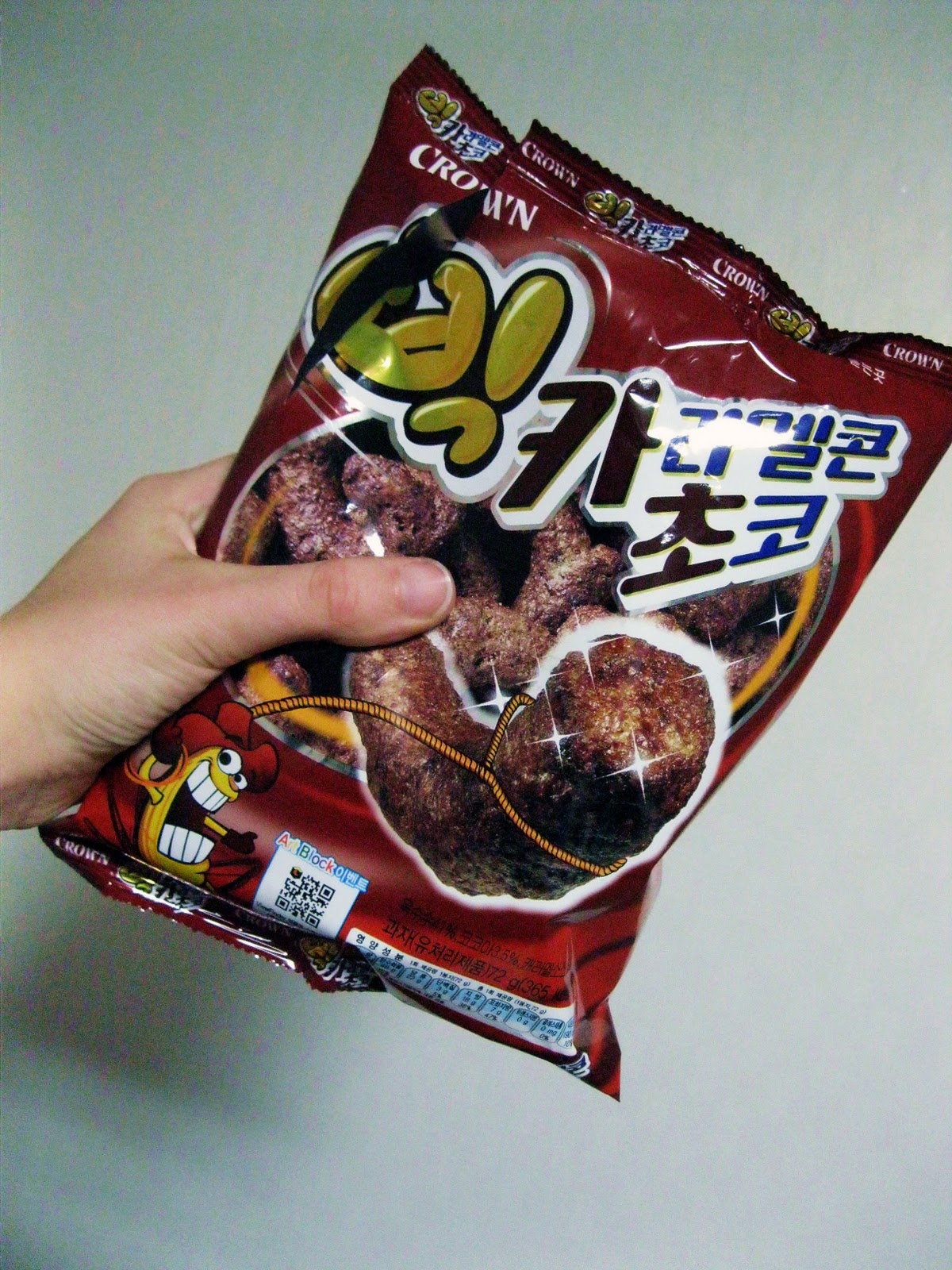
It says you are chocolate but...
I'm really not sure.


And here's a picture of the bag, just so nobody thinks anything funny is
going on.


The bag indicates that these are called, "Big Caramel Chocos." They have the taste of Count Chocula, but obviously the shape of something that crazy vampire would find in his toilet.

Yummy.
Share |